The Evangelical-Lutheran Church of Norway, which has been Norway's official state church, has cut one -- but not all -- ties to the state. The national constitution now refers to it as the "national church" rather than the "state's public religion." Yet the key change is that the state will no longer appoint clergy for the church.
However, many other church-state ties remain in place, e.g., clergy are still considered civil servants, and the state will still fund the church. So this change is not an overly dramatic one. The state will still have a lot of influence in the church by being its primary source of funds. See this short article here.
Monday, January 9, 2017


Friday, December 30, 2016
Frank R. Wolf International Religious Freedom Act of 2016
On December 16, 2016, President Obama signed into law a new version of the International Religious Freedom Act from 1998. The older law established the USCIRF, a government commission we will learn about in class, in an effort to protect religious freedom. The interesting thing about this new version of the law is that it explicitly accords the same protection to atheists and other non-religious persons. The new law can be found here. An RNS article can be found here.
That the new language has been included is not surprising if you have been following trends in religion and church-state relations. In fact, the new language reflects two larger trends that have been going on for some time in the U.S. First, there is growing acceptance of atheists and non-religious persons more generally in the U.S. Though still a small percentage of Americans, their numbers are growing and with lots of public attention. Second, for some time legal rulings have used functional rather than substantive definitions of religion. It is not a belief in god or gods that has merited legal protections but rather any sort of belief system that a person claims, even if that belief system is explicitly atheistic.
What will be interesting is to see how this change in the law is reflected in future USCIRF annual reports on religious freedom around the world. Will future reports give increased attention to persecution of atheists?
UK Commission Rules Jediism not a Religious Charity
The Charity Commission for England and Wales officially ruled earlier this month that Jediism is not a religious charity. The official report can be found here, and this article provides a useful summary. The difficult path for acceptance for Jediism goes back years (see this earlier post from 2011), and this ruling gives a sense of finality to the matter... at least temporarily until more efforts are made for wider acceptance of Jediism.
The Commission is tasked with identifying which organizations be given official charity status. Despite the headlines for some news articles, this ruling does not declare that Jediism is not a religion. It instead ruled that the particular group that applied for recognition as a religious charity -- the Temple of the Jedi Order -- does not merit that recognition because they determined that the group was not organized for "exclusively charitable purposes for the advancement of religion and/or the promotion of moral and ethical improvement for the benefit of the public." Those that associate themselves with this group may consider their beliefs and practices to be religion, but they will not receive the legal benefits accorded to other recognized religious groups in the U.K.
Although the origins of Jediism in the U.K. are actually tied to a joke answer given on the government census, this latest event illustrates the complexity of defining religion. See the official report in particular. Using case law as a guide, the Commission only considers a group to have religious status if it has a certain level of cogency, seriousness, cohesion, and importance. The report lays out how Jediism fails to meet this standard. At one level, the report reflects common sense that ideas taken from a fictional movie should not be given the same status as those from historical religious figures. Yet, the argument laid out in the report makes numerous suppositions of a very subjective nature. For example, it gives credit to a similar New Zealand ruling that Jediism is a set of interconnected ideas rather than a structured coherent religion. Exactly where is the line drawn between set of interconnected ideas and structured coherent religion?
This story is not over. The British Jedis will continue the fight, and if they do so long enough I suspect they will get that recognition. It always takes new groups time and effort to achieve recognition. The Jedis just need to stick around long enough, act sufficiently like other religious groups (have meetings, be seen in public doing good deeds, codify their teachings, etc.) in the meantime, and they will then get the recognition they want. Will they last that long, or is their future bleak and their peak limited to a time long ago in a galaxy far, far away?
Gallup's Five Key Findings on Religion in the U.S.
Gallup recently released a summary of key findings on religion in the U.S. Below I list the five key findings word-for-word but without explanation; for explanation see their site here.
- America remains largely a Christian nation, although less so than in the past.
- The trend away from formal religion continues.
- A majority still say religion is important in their eyes.
- Americans continue to say that religion is losing its influence in American society.
- Religion remains intertwined with political self-identification.
Wednesday, November 2, 2016
Probably No Ordination of Women in the Catholic Church
Just months ago Pope Francis said that the possibility of ordination of women in the Catholic Church should be investigated (see here). But just yesterday he said that the issue was settled by Pope John Paul II in 1994. According to this article:
Francis was referring to a 1994 document by Pope John Paul that closed the door on a female priesthood. The Vatican says this teaching is an infallible part of Catholic tradition.
The reporter then pressed the pope, asking: “But forever, forever? Never, never?
Francis responded: "If we read carefully the declaration by St. John Paul II, it is going in that direction."Pope Francis's recent remarks were made while speaking in a somewhat informal news conference on a plane headed from Sweden to Rome, so they do not constitute a formal statement. It was also not clear whether he has made the careful investigation that he proposed be done. However, it does signal that he considers the matter mostly closed and so may be less likely to pursue the matter. There is also the matter of women's roles in other forms of leadership (e.g., as deacons), but this was apparently not discussed.
Wednesday, October 26, 2016
Increase in Percent of Americans Raised in Inter-faith Homes
The Pew Research Center has just released the results of a study on inter-faith homes here:
A number of other findings are also reported, such as those from an inter-faith home are much more likely to adopt the mother's religious affiliation than the father's.
[T]he number of Americans raised in interfaith homes appears to be growing. Fully one-quarter of young adults in the Millennial generation (27%) say they were raised in a religiously mixed family. Fewer Generation Xers (20%), Baby Boomers (19%) and adults from the Silent and Greatest generations (13%) say they were raised in such a household.
A number of other findings are also reported, such as those from an inter-faith home are much more likely to adopt the mother's religious affiliation than the father's.
Friday, October 14, 2016
Income Distributions of Different US Denominations' Members
The Pew Research Center recently released the following graphic in this article.
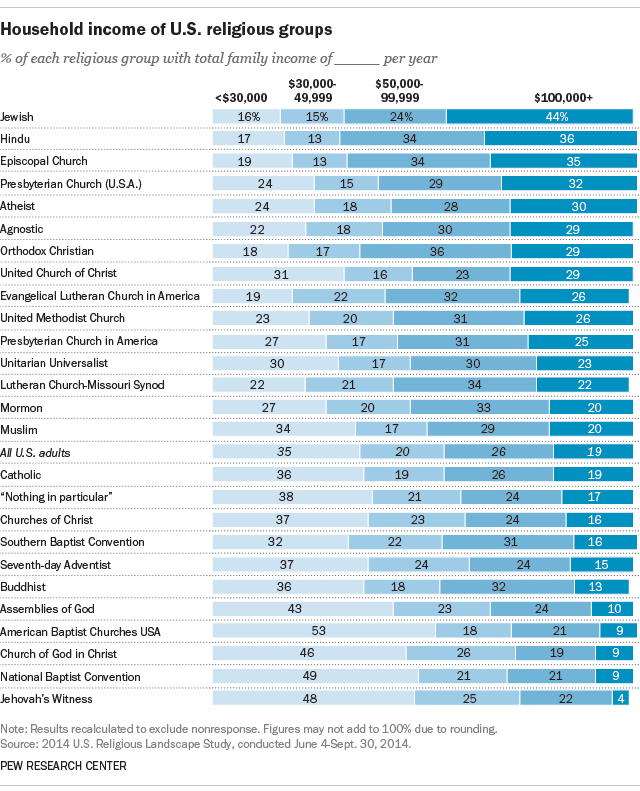
The graph is generated using 2014 data, and it reports patterns that have been in place for quite some time. Jewish and mainline Protestant denominations have the highest income profiles; they also have the highest education rates on average. Stricter churches tend to be closer to the bottom.
The graph is generated using 2014 data, and it reports patterns that have been in place for quite some time. Jewish and mainline Protestant denominations have the highest income profiles; they also have the highest education rates on average. Stricter churches tend to be closer to the bottom.
Reducing the Frequency of Regular Worship Services in the Church of England
A committee tasked with identifying and recommending possible changes to make in the Church of England is considering a change in a church requirement on the regularity of church services. A few facts provide the context. First, there are official church policies requiring that certain worship services be held on certain days and times of the year (Canons B11 and B14), irrespective of how many people are in attendance. Second, the Church of England has experienced tremendous decline in attendance during the last decades. Third, in many rural areas these worship services are held even when only one or two people are in attendance. This results in an inefficient allocation of church resources because a lot of resources are required to produce those worship services. Relaxing the requirement would allow parishes to adapt their worship services to the local conditions. This article summarizes the situation.
Enabling the parishes to better adapt to local conditions sounds like a perfectly reasonable change to make. It frees up clergy and church resources for other ministering activities. However, what those other activities should be is less clear. The Church of England's long-run decline will not be stopped by this change, and holding fewer services does not seem like a spark that will ignite growth.
Perhaps the Church of England can learn from other denominations that consolidate congregations when membership shrinks in an area. For example, parishes could be closed or combined, e.g., combining two small, struggling parishes into one larger, thriving one. The Church of England is congregationally based, so having thriving congregations will be the key to success because it is in the congregations that most religious production and consumption occurs.
This story also highlights a tension that can exist between congregation and denomination. The denomination's policies require the congregations to undertake certain very costly activities that yield relatively low value due to the poor attendance. Relaxing denomination policies to grant more autonomy to the parishes would allow the parishes better latitude in adapting their activities.
Subscribe to:
Posts (Atom)

 Posts

